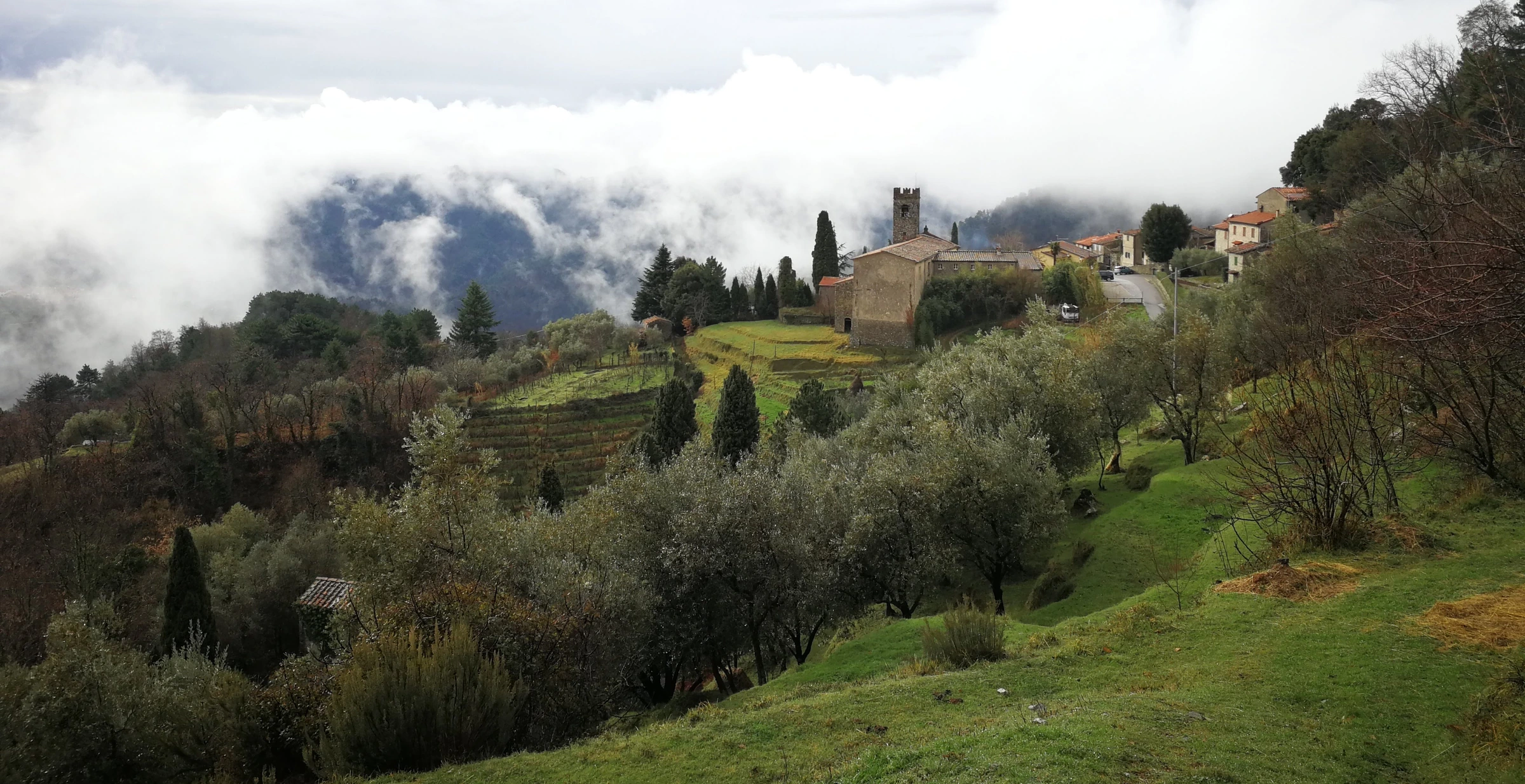
We spent a long time looking for a piece of land in the hills above the sea.
There were plenty of beautiful places nearby. We went to see them and imagined how we might spend time there with the children.
But that was all they were. Beautiful.
Then we went up to Gombitelli for the first time.
And almost immediately, we found no shortage of perfectly good reasons not to move there.
Land.Seasons.Biodiversity.
From our photo archive
1–3 / 7
Read the story: Where Our Hearts Stayed
Where Our Hearts Stayed
Until 2015, we lived down by the sea in Lido di Camaiore.
Our children were small, and more and more we wanted to find a little piece of land somewhere in the nearby hills.
Not a farm. Not a business. And certainly not the start of some big project.
Just a place of our own.
Somewhere we could take the children, pitch a tent, plant something, spend the day among the trees, and go home in the evening.
We drove around the hills looking at plots of land.
Some were genuinely beautiful.
We took photos, talked about them, and imagined what it would be like to spend time there.
But something odd kept happening.
We liked them. That was all.
Beautiful.
And that was as far as it went.
In the spring of 2015, we saw a listing for a house in Gombitelli.
Buying a house wasn’t part of the plan at all back then. The listing had been up for several months, and we called mostly out of curiosity.
The house was still for sale.
We arranged to see it.
And the drive up alone made us seriously wonder whether the whole idea was crazy.
The Road Up
For me, there was another, very personal reason why that road was difficult.
I wasn’t learning to drive for the first time. We’d had a car back in Ukraine and had already taken some fairly long trips in it. Then, in 2008, we had a serious accident. We went off the road in Crimea and rolled into a deep ravine. It was a miracle that no one was killed or seriously injured. The car, sadly, was beyond repair. It was seven long years before I wanted to get behind the wheel again.
In Italy, I had to get my driver’s license all over again. I got it on April 1, 2015.
And on April 16, I bought a used car.
I deliberately chose a car almost exactly like the one I’d crashed in, only this time with a stick shift. I thought it would give me more control. I guess it was my way of getting back to driving—and to the person I’d been before the fear took hold.
There was no time to ease into it.
The car was for sale in another region.
I had to travel nearly two hundred kilometers to pick it up, then drive all the way back myself in a car I’d just bought.
And it was around that same time, in April 2015, that Gombitelli came into our lives.
The road to the place we’d unexpectedly fallen in love with stirred up every fear I still had. There were tight mountain curves, oncoming cars and trucks, steep slopes, and stretches with no guardrail, where you could see all too clearly how far down it went.
So on that first trip to see the house, and for some time afterward, we asked ourselves in all seriousness:
“What if the road alone is enough to keep us from coming up here?”
Friends who’d been driving for years told us to think twice.
On one of those first trips up the hill, our newly bought car was hit. A car coming down too fast couldn’t slow down in time on a wet curve. It skidded and crashed into us, even though we’d managed to stop and were already a few meters past the curve.
We were completely unprepared for any of it. Cars coming the other way were often going too fast. Experienced drivers sometimes got so used to the road that they forgot the risks. People were in a hurry or tired. And the road itself really was narrow, potholed, and often overgrown with tall grass and acacia shoots.
Even after all that, we decided to live here.
And the question stopped being theoretical.
On those first drives home, I would go up the hill in tears, praying. Really praying.
But my children were up there.
Our home was up there.
And I had to get there.
First, the impossible became merely difficult.
Then the difficult became familiar.
And one day, that road became the road home.
This is how narrow it is.Uphill through the woods, around a curve, on a narrow road.The crash on the road up, before we bought the house.
Our First Day in a Place of Our Own
We still have a few completely unstaged photos from the day the house finally became ours.
The very first photo, taken the day we bought the house.
One of our first views from the house. We’d once come to view this house when it belonged to someone else. Now it was where we were going to live.
We packed our things and moved up there with two small children, though we kept paying rent down by the sea for a while longer.
That was when we found out that deciding to live in the mountains and living in the mountains every day were two different things.
The road hadn’t gotten any safer.
Little by little, it had simply become ours.
The very first photo, taken the day we bought the house.Our first look out from a home of our own.
The Place We Couldn’t Stop Photographing
For the first few years, we hardly ever put the camera down.
I guess at first it was a way of making sure it was all real.
SILENCE. Mist. Sun and rain. The smell of grass and flowers. Sheep in the village. And amid all that quiet, so much life and so many sounds. Extraordinary birdsong, insects buzzing, roosters crowing, dogs barking. And hardly a human sound.
Sunsets that really did take your breath away.
Before long, we realized something else about this place.
You can’t say:
“Summer is the most beautiful season.”
In autumn, the sky puts on a show.
In winter, the sunsets are almost impossible to believe.
Within minutes, mist can hide the whole world around you.
Sometimes snow settles on the roofs and olive trees.
Some evenings look as though nature got a little carried away with color.
All we’d been looking for was a little piece of land where we could spend time with the children.
What we found was a place that gradually reshaped our lives. And it changed us too.
Gombitelli in winter, 2018.One of those dramatic sunsets.
We came here as city people who knew next to nothing about farming.
At first, we did everything we thought we were supposed to do. We dug, fertilized, watered, tried to improve the soil, and protected what we’d planted. We thought back to how our grandparents did things in the countryside, where we’d helped them plant potatoes and other crops as children.
We were ready to work harder.
It took us a while to realize that the land might need something else entirely.
A living land,a promiserenewedevery day.
Read the story: The Land That Said No
The Land That Said No
That first spring here, we wanted to plant everything.
Potatoes, tomatoes, cucumbers. Grapevines. Fruit trees. Flowers.
Maybe it was city-people confidence. If you prepare well enough, work hard enough, and do everything “right,” you’re bound to get results.
We started with the vegetable garden.
We turned the soil and used machinery where we needed it. We bought topsoil and huge bags of worm castings made from horse manure that red wigglers had processed. We dug trenches and filled them with branches and organic matter. We mulched. We also tried a biodegradable, compostable mulch film made from cornstarch to cut down on evaporation without leaving microplastics in the soil at the end of the season.
And we watered.
We watered a lot.
The soil here is heavy clay loam, full of rocks. Sometimes it seems like there are more rocks than soil. There’s bedrock underneath, and the layer the plants have to grow in is nothing like the deep, loose black soil we were used to in Ukraine.
We tried to fix that layer.
We added whatever we thought it was missing.
When something didn’t grow well, our first thought was always the same.
We need to add more.
More good soil.
More organic matter.
More water.
More work.
Sometimes it worked.
Most of the time, the results weren’t worth the effort.
The tomatoes gave us pretty modest yields. Potatoes, cucumbers, peppers, eggplant, and onions did better, though still nowhere near well enough to justify the whole system we’d built around them. Our table grapes took years to bear fruit at all, and even now they need a lot of water.
Then we found out that getting something to grow was only half the battle.
Because we aren’t the only ones living here.
At first, things we’d planted went missing.
Then we started finding tracks.
Eventually, we had to put up trail cameras to see what was happening at night.
It turned out we had visitors after dark. Wild boar, porcupines, badgers, roe deer, and foxes. The birds know exactly when a piece of fruit is ripe. Some animals dig things up. Some tear up our lovely beds, even the ones covered with mulch or film. Some take a bite. Some come back for more.
One night, a trail camera caught a badger calmly eating our grapes, one whole bunch after another.
He clearly had no doubts about who we’d grown them for.
We tried to avoid harsh chemicals. When diseases or pests showed up, we used gentler treatments approved for organic farming, including insecticidal soap, neem oil, and kaolin clay.
Over time, though, we ran into a much bigger problem.
You can keep perfecting an aphid treatment forever.
It won’t do you much good if something digs up half the bed overnight.
You can bring another bag of worm castings up the mountain.
At some point, you have to ask yourself whether it makes sense to haul soil, water, and fertilizer up here every year for a plant that might not want to grow here without all that help.
Organic soil for our first plantings.Biodegradable, compostable mulch film.A badger caught on a trail camera.
The Potato Project
One year, we decided to do everything by the book with our potatoes.
We bought good-quality seed potatoes from varieties we’d chosen carefully. We even ordered some from France.
For each one, we dug a hole and cleared out the rocks and heavy soil.
We filled the holes with good soil we’d brought in.
We added worm castings.
We planted the potatoes.
We tended them.
We watered them.
And the potatoes really did grow. A porcupine got most of the harvest.
Later, a few volunteer potatoes taught us even more. Our little thieves had accidentally “planted” them here and there among other plants. The same animals mostly left them alone, and we hadn’t set up a whole little farming operation around each one.
It wasn’t a method yet.
At first, we didn’t even understand what we were seeing.
Little by little, we started noticing more things like that.
Seed potatoes from varieties we’d chosen carefully.Potatoes planted on our land.Potatoes and other crops growing on the slope.
The Watermelon and the Pumpkin
We watered the watermelons nearly every day. We tried starting our own from seed and buying seedlings.
One watermelon grew.
Meanwhile, a few steps away, something much more interesting was happening.
A pumpkin seed had fallen in the garden by chance.
Nobody had prepared a spot for it.
Nobody had ordered seed for it.
Nobody had pulled out rocks, filled a hole with store-bought soil, or made a schedule for fertilizing and watering it.
It just sprouted.
Then came a pumpkin. A big, beautiful one.
And then another.
At that point, we still didn’t have a clear theory.
We kept digging, buying soil, trying new varieties, and building increasingly complicated systems around the plants we wanted to grow.
At the same time, we began to notice a strange pattern.
With some plants, we had to keep proving they belonged here.
Others just lived.
Pear trees.
Fig trees.
Persimmons.
Raspberries.
Some old grapevines.
Pumpkins nobody had planned to plant.
And little by little, our approach began to change.
At first we’d asked ourselves one question.
“What else do we need to do to get this to grow here?”
Then the question changed.
“Why does this one grow almost entirely on its own, while that one only survives as long as we keep it going?”
Finally, we asked ourselves something else.
“What if we paid closer attention to what the land is already trying to tell us?”
We watered it nearly every day.A pumpkin growing from seed on its own at the base of a tree.
What the Soil Map Later Showed Us
Later, the Tuscany Region’s official soil database helped us put into words what we’d simply called “difficult soil” in those early years.
Chemically speaking, the soil wasn’t necessarily poor.
The boundary between two different soil units runs through our property. One part is in Land Capability Class IVe, with good chemical fertility in the topsoil and serious limitations related to slope and erosion. The other part is in Class VIse, with a shallower effective soil depth and additional soil limitations.
The problem was more complicated than just needing more fertilizer.
We’re on a terraced mountainside with physical limitations that another bag of good soil can’t fix.
What the Research Says
We later found that one approach we’d arrived at through experience—disturbing the soil less and keeping it covered with vegetation longer—fits with research on Mediterranean hillsides.
In a 12-year experiment in southern Italy, systems that used minimum tillage or strip tillage, retained crop residue, and kept the soil covered longer had substantially lower soil losses than conventional intensive tillage. Average losses in the two systems that best conserved soil were about 9–14 metric tons per hectare a year, compared with about 55 metric tons per hectare a year under conventional cropping. Those measurements came from experimental plots in Calabria.
A separate study of sloping Mediterranean vineyards also linked bare soil and tillage to increased surface runoff and soil loss during rainfall.
Short version for the site
Research suggests that keeping vegetation on the ground and tilling less can substantially reduce water erosion on Mediterranean slopes.
Sources for the Bibliography
1. Preiti G., Calvi A., Porto P., Romeo M., Monti M., Bacchi M. Long-term effects of different arable cropping systems on surface erosion processes and C-factor in hilly Mediterranean environment. Soil & Tillage Research, 223, 2022, 105480. DOI 10.1016/j.still.2022.105480.
2. Rodrigo-Comino J. et al. Understanding soil erosion processes in Mediterranean sloping vineyards (Montes de Málaga, Spain). Geoderma, 296, 2017, 47–59. DOI 10.1016/j.geoderma.2017.02.021.
We still thought we were learning how to grow plants.
What we were beginning to learn was how to observe.
At some point, we stopped asking what else we needed to add to the soil.
We started watching what happened when we left the soil undisturbed, held back on mowing, watered fewer plants, and gave things time before trying to fix whatever seemed wrong.
Once we stopped intervening all the time, we saw how much had been happening on our land all along.
Land.Seasons.Biodiversity.
From our photo archive
1–3 / 6
Read the story: We Stopped Fighting and Started Observing
We Stopped Fighting and Started Observing
The change didn’t happen overnight.
We didn’t wake up one morning and announce:
“From now on, we’re doing everything differently.”
We kept going with our old experiments for quite a while.
We still dug a little.
Fertilized a little.
Watered a little.
We cut the grass.
We bought plants we wanted to see growing here and kept trying to figure out why some thrived while others needed almost constant care.
Little by little, the question itself changed.
Whenever we saw a problem, we used to ask:
What do we need to do?
Now we were more likely to ask:
What if we do nothing for now and see what happens?
Carefully shaped garden beds. Our old approach didn’t disappear overnight.
Not All the Grass Was a Problem
In the early years, tall grass seemed like something we had to fight.
The grass covers the ground.
It gets in the way.
It grows between the trees.
It makes the place look neglected.
It can hide dangerous visitors, like vipers and other wild animals.
So it has to go.
But once you stop looking at the land as a picture that has to stay neat, you start to see a completely different system.
Tall grass shades the soil.
Underneath it, the ground stays cool and moist longer.
When plants complete their life cycle, some of that plant material stays right where it grew.
In spring, flowers come up everywhere among the grasses.
Then the insects arrive.
Suddenly, the thought “We need to clear this” gives way to another.
“Wait a minute. What’s already working here?”
We started mowing much less.
Mostly where we actually needed to get through.
Over time, “mowing the whole place” turned into something else.
Mow paths through a living landscape.
A tiny difference in wording.
A huge difference in what happened on the ground.
People can still get through.
We still take care of the land.
And most of what grows here gets to finish its life cycle.
A path through ferns, grasses, and flowers.
The Same Thing Happened with the Soil
We’d known for years how hard it was to dig here.
Rocks.
Clay.
Roots.
The slope.
So at first, it was almost a relief to stop working the soil all the time.
We stopped assuming that all the soil needed to be turned over regularly.
If we wanted to plant something, we could make room for that one plant.
The ground around it could stay as it was.
Little by little, the shovel went from being a tool for working the whole property to a tool for a specific job.
Plant a tree.
Dig a hole.
Tidy up an edge.
And leave the rest alone.
This didn’t mean “do nothing.”
Observing turned out to be hard work in its own right.
We had to notice where water lingered longest after rain.
Where the ground dried out first in summer.
Where frost hit more often in winter and in spring and fall, and where it stayed warmer.
Where the same plant kept coming up.
Which spots the insects chose.
Which plants made it through winter without protection.
Which ones could take the heat.
Which animals used the same paths over and over.
Where seeds sprouted on their own.
And where we could spend months creating ideal conditions and still see hardly anything happen.
Working by hand among the plants.
We Started Leaving What We Used to Haul Away
More and more, we left what we cut right on the ground.
We stopped automatically treating branches as waste.
What we used to haul away gradually became material we could use right there on the land.
Cut grass could cover the ground.
Small branches could stay where they were and break down.
Larger ones could help shape slopes and define edges.
Fallen leaves could stay where they fell.
The tall, beautiful lupines made a great green manure and held their own against the weeds. They kept coming back in the same spots for years because we let their seeds ripen and scatter on their own.
We still didn’t know what all of this would turn into.
But we were beginning to see something simple.
If working the land meant taking away everything it grew each year, then buying organic matter and hauling it back up to replace what we’d removed, something about that system didn’t add up.
Cut grass and stems laid along the beds and furrows.
Then Came Another Experiment
We began sowing plants for more than the harvest and letting them reseed on their own.
Mustard.
Vetch.
Phacelia.
Lupines.
Borage.
Flowers.
Some would cover the soil.
Some would add organic matter.
Some would feed insects.
The ones that interested us most were the plants that, once they’d appeared, kept coming back on their own.
This was a different way of working with the land.
A plant we buy, grow, water, and plant again every year tells us mostly about our own efforts.
A plant that ended up here once and decided to stay tells us something about the place itself.
Gradually, the whole place began to feel like one big experiment.
Only this experiment ran in reverse.
We used to set the conditions and see what happened.
Now, more often, we let the conditions show themselves and watched who made the most of them.
That was when we really began to notice the plants we’d always thought of as part of the background.
The pear tree that didn’t share our doubts about the quality of the soil.
The raspberries and blueberries that were gradually taking up more space.
The fig tree.
The persimmon tree.
The old grapevines.
The sage we’d bought as a tiny plant at the supermarket.
The rosemary and lavender we could propagate from cuttings.
And the pumpkins that would turn up where we’d never planned a vegetable garden.
They all seemed to be asking us the same question.
Why have you spent so long looking only at what doesn’t work here?
What We Noticed
Some plants can survive here without being useful to us.
We don’t need to keep everything that comes up on its own.
And a crop can be worth keeping even if it needs water or care.
We weren’t looking for a rule that said “the less you do, the better.”
We were looking for a different balance.
Where were we actually helping the system? And where were we wearing ourselves and the land out trying to make it fit our idea of what it should be?
What We Started Doing
Disturbing the soil only when we need to.
Mowing mainly along paths and in areas where we work.
Keeping the ground covered with vegetation longer.
Leaving some of the organic material where it is.
Watching what reseeds on its own.
Scattering pits from our favorite fruit around the vegetable garden.
Propagating plants that have already shown they can live here.
And asking ourselves more often, before buying another product, fertilizer, or plant:
“What’s already working here?”
What the Research Says
We arrived at some of these choices by watching what happened on the land. Later, we found that they lined up with findings from several studies. The studies were conducted elsewhere, under conditions that differ from those at Gombetea.
In a long-term experiment on Mediterranean hillsides, conservation farming practices and permanent grass cover substantially reduced soil loss from water erosion compared with more intensive tillage. In a separate study of sloping Mediterranean vineyards, bare soil was associated with greater surface runoff and soil loss during rain.
Another study helps explain the effect on soil temperature. In a multiyear experiment in a dry steppe ecosystem, intensive mowing raised daytime soil surface temperatures and reduced soil moisture compared with unmowed areas. The climate there is different from ours, so the takeaway for us is a cautious one. Vegetation can keep the soil surface from getting too hot, help it retain moisture, and make it less vulnerable to erosion.
Sources
1. Preiti G., Calvi A., Porto P., Romeo M., Monti M., Bacchi M. Long-term effects of different arable cropping systems on surface erosion processes and C-factor in hilly Mediterranean environment. Soil & Tillage Research 223 (2022), 105480. DOI 10.1016/j.still.2022.105480.
2. Rodrigo-Comino J. et al. Understanding soil erosion processes in Mediterranean sloping vineyards (Montes de Málaga, Spain). Geoderma 296 (2017), 47–59. DOI 10.1016/j.geoderma.2017.02.021.
3. Shao C., Chen J., Li L., Zhang L. Ecosystem responses to mowing manipulations in an arid Inner Mongolia steppe: An energy perspective. Journal of Arid Environments 82 (2012), 1–10. DOI 10.1016/j.jaridenv.2012.02.019.
We’d come here with a long list of plants we wanted to grow.
Now we were curious what kind of list the land itself would make.
Cover crops taller than we are.Borage growing among other plants.
When we stopped looking only at what wasn’t working here, a whole different list of plants came into view.
Some needed water, fertilizer, protection, and constant attention.
Others made it through the heat, the winter, the animals, and our own mistakes. And they kept coming back.
Little by little, those plants began to shape what Gombetea could become.
A living land,a promiserenewedevery day.
Read the story: What the Land Chooses
What the Land Chooses
For a long time, we judged most plants the same way.
We planted them.
We watered them.
We fertilized them.
We waited for the harvest.
Then we compared what we got with what we’d hoped for.
After a few years, we realized that “How much did it produce?” was only one of the questions.
There were other things to count.
How much water it took.
How often we had to step in.
How much soil and fertilizer we had to bring in.
How badly the plant was affected by disease.
Whether we had to protect it from the sun.
Whether we had to protect it from animals.
And what happened when we simply left it alone for a while.
Little by little, we found ourselves judging plants by a different standard.
Until then, we’d asked:
“Can we grow this here?”
With enough resources, you can grow almost anything.
Now we were asking:
“How naturally does this plant fit into life here, and how much work and money does it take to get a result we’re happy with?”
Pear Trees
Some answers were simple.
Pear trees do well here.
They grow, bear fruit, and get by without an elaborate setup around them.
Of course, there are things we can do to help a tree.
We can prune it.
We can help it through an especially hard season by watering it or using natural methods to deal with pests.
We can pick the fruit before someone else gets to it.
Still, the difference is easy to see.
We don’t have to talk a pear tree into living here all over again every year.
It’s already happy to stay.
A fruit tree that does well here.
Persimmon Trees
It was much the same with persimmons.
They make it through our winters.
They make it through the summer.
They produce fruit.
And then fall comes around, and it suddenly becomes obvious how strange our old way of thinking about the land was.
We were trying to coax a few kilos of vegetables out of the ground, pouring in water, bringing in soil, and putting in hours of work. Right beside them, a tree stood quietly bearing fruit.
The tree was doing well because this place suited it. The right fertilizer had nothing to do with it.
Persimmons growing on the property.
Fig Trees
With fig trees, the conversation turned out to be much easier.
We don’t have to prove, season after season, that they belong here.
They grow.
They bear fruit for us and for the other creatures that live here.
We can make jam with the fruit.
And it all follows a wonderfully short chain:
place → plant → fruit → food.
The longer we lived here, the more we came to value short chains like that.
Jam: place → plant → fruit → food.
Raspberries
Some plants did more than survive.
They began to claim space.
Raspberries were one example.
At first, there was the one raspberry bush we’d planted ourselves.
Then it gradually outgrew the little patch we’d set aside for it.
New shoots came up.
It chose its own spots.
And at some point, it just took off.
If you’re used to seeing a tidy row of plants as a sign of success, that changes how you look at things.
Sometimes the clearest sign that a plant suits a place is the moment it stops needing us to tell it exactly what to do.
A crop that grows well and keeps spreading.
Old Grapevines
Some of the plants had been here long before us.
The previous owners’ old grapevines produce small wine grapes.
They don’t look like the perfect table grapes you see at the grocery store.
The bunches are sometimes smaller.
So are the grapes.
But those old vines can get by here with hardly any watering.
The table grapes growing right next to them were a different experience.
We can grow them here, too.
They produce fruit.
But it takes a lot more water, fertilizer, and attention.
Both can grow here.
But they tell two different stories about the place.
One says:
“I can live here.”
The other says:
“I can live here as long as you keep giving me the conditions I need.”
For us, that difference gradually came to matter more than the size of the grapes.
Grapevines planted by the previous owners.
Olive Trees
An olive grove came with the house. About 75 trees, many of them clearly very old. When we first came to live on the hill, we could hardly believe that all of it, dozens of olive trees, was really ours. At first, we didn’t dare touch them for fear of doing something wrong. Then I did what I usually do when I’m faced with something unfamiliar. I read everything I could about caring for olive trees, pruning them, and protecting them from pests.
It took us about two years to get around to pruning. We hired professionals, spent quite a bit of money, and learned from them as they worked. We chipped the pruned branches, laid the chips along the edges of the slopes to form low berms, and covered them with soil so the ground would hold on to moisture and nutrients. We even picked olives by hand and cured them in brine.
Over time, we realized that being as careful as we could with the trees still left us with some practical problems. We didn’t use chemical treatments, wanted to pick the olives by hand or harvest them as gently as possible, and held ourselves to strict standards for keeping things natural. But getting oil meant hauling the olives uphill, practically by hand, then paying someone to take the harvest to an olive mill. That alone was almost impossible for us. We had no tractor and little money to pay someone to do it.
It was our concerns about milling that finally stopped us. We’d heard plenty of stories about people getting back oil that wasn’t made entirely from their own olives. By some accounts, none of the olives they brought in ended up in the batch they took home. And even if you find a mill that will process your olives separately, it can be hard to know whether the equipment will be cleaned thoroughly before your batch. Some oil from another batch could end up in yours, and it might be of a very different quality.
That’s how we came up with the idea of having a small olive mill of our own. We could process the olives right here, in the spirit of chilometro zero, the Italian idea of keeping food production as local as possible. In theory, we could also make oil for our neighbors in the village, who have to take their olives down the hill to other mills, just as we do. It would be a small but meaningful way to give something back to our community. We had too many other expenses at the time, so we set the idea aside. But it stayed with us.
How much might it cost? Our rough estimate is €12,000–€20,000. That covers a small used processing line, professionally inspected and refurbished, as well as delivery, fitting out the space, and the required paperwork. That estimate takes into account the space we already have, which could be adapted for the mill, and our registered small farm. I run the farm as a coltivatrice diretta, a farmer who works the land herself.
Equipment from private sellers starts at around €6,000. For us, the lower price isn’t worth the risk of ending up with a mill we can’t rely on over time.
These figures are still estimates. We’re looking for the simplest, most affordable way to make it happen.
Blueberries our family planted.
Blueberries
We planted the blueberries ourselves.
They turned out to be another crop that does well in certain spots and can give us a good harvest in season.
We still water, stake, and fertilize them.
Even so, that’s nothing like the crops that need a whole support system rebuilt around them every year.
And Then Came the Sage
Some plants have humble beginnings.
Years ago, we bought a couple of small sage plants at the local supermarket.
Those cheap little pots of herbs, about a euro each.
We had no plan for them.
We just planted them.
They grew.
Then they spilled over onto the terrace below in great green cascades.
It was plants like these that got us thinking about a new principle.
If a plant is telling us so plainly “I’m happy here,” why keep treating that as a fluke?
Why not just grow more of it?
What would happen if we gave more space to the plants that were doing well here and spent less time trying to keep the struggling ones going?
That question would eventually take us much further.
To rosemary.
Lavender.
Oregano.
Bees.
And the idea of a whole purple slope, the Purple Hill Concept.
And it all started with one little sage plant.
We Still Chose to Grow Some Plants That Needed More Care
This matters to me.
It would have been easy to say:
“If a plant needs watering, it isn’t for us.”
That would have been too simple.
Lettuce needs help in the summer heat. We might still want to grow lettuce.
Some berries need water.
A young tree might need support for the first few years and then get by almost entirely on its own.
Some plants matter enough to us to be worth the extra work.
The question had changed.
Do we understand what this choice will cost us, and are we willing to put in what it takes?
Does that make sense here, on this particular piece of land?
Until then, we’d treated almost every plant as an equally good candidate and tried to give each one the conditions it needed.
Now the land was starting to do the choosing.
The pattern left room for exceptions.
It was still taking shape.
But it was hard to argue with what we were seeing.
Some plants seemed to say:
“I’ll stay if you keep taking care of me.”
Others said:
“Help me a little, and I’ll take it from there.”
And some asked for almost nothing.
They just grew.
What We Noticed
The most useful measure wasn’t the size of the harvest.
What mattered more and more to us was the balance between what we got / how much water it took / how much work it took / how often we had to step in / how well the plant held up.
That showed us something a photograph of a beautiful harvest couldn’t.
What We Started Doing
Propagating more of the plants that had already shown they could hold up here.
Keeping volunteers—plants that came up on their own—where they fit in.
Watching where a plant chose to grow.
Comparing varieties by how much they needed to thrive, as well as by the flavor and size of their fruit.
Leaving tall grass around plants where it helped hold moisture and provide shade.
And gradually shifting our attention:
from what we wanted to get from the land to what the land was already willing to support.
At first, we made a list of what we wanted to plant.
When we moved here, we thought a lot of plants simply couldn’t grow at this elevation.
We still get snow in winter, though less often now. We get frost in spring. The weather on the hillside can be quite different from the weather down on the coast.
Over time, some plants began to surprise us and upend our ideas about what should and shouldn’t grow here.
One of the first was a yellow-flowering mimosa.
Land.Seasons.Biodiversity.
From our photo archive
1–3 / 9
Read the story: A Mimosa in Bloom at Nearly 500 Meters
The sea isn’t far away. On a clear day, we can see it along with the valleys and the distant horizon. No buildings block the view from the house or the property.
Even so, the climate up here is noticeably different from the climate on the coast.
We get snow in winter.
These days, it snows only a few times each winter, sometimes not at all. When it does, the snow usually stays on the ground for just a few hours. People who’ve lived here a long time say it used to stick around much longer.
Our slope faces southeast, and that turned out to be one of the advantages of the place.
In winter, the low sun hits the open slope directly, fairly early in the day. The ground begins warming in the morning, and the incline changes how the light falls compared with level ground.
In summer, something interesting happens.
The sun still reaches us early, so mornings warm up quickly. Later, when the heat turns oppressive down on the coastal plain, it feels noticeably milder up here.
Gradually, we realized that “nearly 500 meters above sea level,” on its own, tells you very little about the climate.
It also matters which way the slope faces, what lies in front of it, how the wind moves across it, where cold air settles, and when the sun reaches it.
And that’s where some plants began to surprise us.
One of the first was the mimosa.
The mature mimosa near the house.
March 1
We bought the mimosa in a tiny pot at the grocery store.
We still have a photo from before we planted it.
A young plant in a pot.
Nothing about it suggested that, a few years later, it would be one of the most striking plants near the house.
We took a chance and planted it in the ground, even though we knew how cold winters could get at our elevation.
The mimosa nearly froze to death its first winter in the ground. We held our breath, waiting to see whether it would recover from the cold.
It survived.
Then, on March 1, 2018, our wedding anniversary, it snowed.
The mimosa was already in bloom, and suddenly it was covered in snow.
In Italy, mimosa is the flower traditionally given on March 8, International Women’s Day. Seeing it under snow a week earlier was an almost comical sight.
March 1, mimosa blossoms, and snow.
We worried again that it wouldn’t make it.
Then the snow melted.
And the mimosa was still there.
It made it through the next winter.
And the next.
Years went by.
That little potted plant is now a tree several meters tall.
It blooms every year.
And it blooms very early, when little else around us is in flower.
One day, we noticed it had company.
Bees.
What had started as an experiment—“Will it make it?”—had become part of a very different story.
It was a story about food for insects. In January and February, few plants around us offer bees that much pollen. For our bees, the mimosa became an important early-season food source, just as the colonies were slowly becoming active again after winter.
The young mimosa in its pot before we planted it.A snowman with mimosa blossoms on March 1, 2018.
Yucca
The yucca also started out as a small potted plant from the local grocery store.
It was an ordinary houseplant that was struggling in its pot.
We planted it outside to see whether it would grow there or whether that would be the end of it.
It grew.
It got snowed on.
At first, we wrapped it up for winter to protect it from the cold.
Some years, it came out of winter looking as though the experiment might be over.
Then it would recover.
Today, it’s a huge yucca that barely resembles the little potted plant it once was. After 11 years in the ground, it bloomed for the first time.
The young yucca in the snow beside its winter cover.The yucca today, after years of growth.
Avocados
The avocados were a different story.
We never set out to grow avocados.
We eat them, and I always hate throwing away the pits.
I sprout some of them.
Others go straight into the ground as an experiment.
Some plants die.
Some make it through the winter.
Some are already taller than we are.
We’re still a long way from an avocado grove or a reliable commercial harvest.
What we have is a long-running experiment built around one question.
How far can we push the limits of what can grow in this particular microclimate?
Mango
We kept our little mango tree sheltered for years, too.
It had already produced fruit in its pot before we decided to plant it in the ground.
We chose an especially warm spot against a wall.
It has lived outdoors there, winter and summer, for several years now.
It flowers.
It sets tiny fruit.
So far, the fruit has always dropped long before ripening.
And that’s where the story has to stop for now. The experiment is still underway.
The mango tree back when it was growing in a pot.A mango our tree produced while it was still in a pot.The ongoing experiment by the warm wall.
We’ve Grown More Careful with the Word “Impossible”
On their own, the mimosa, yucca, avocados, mango, and the rest don’t prove that the climate here has changed or that any subtropical crop can now grow at nearly 500 meters.
What they do tell us is that “At this elevation, it’s impossible” is too simple a rule.
The microclimate is more complicated than that.
A plant responds to all the conditions around it. An elevation figure on paper tells only part of the story.
What the Research Says
A slope’s orientation and steepness shape how much solar energy it receives and when. Differences in orientation, in turn, influence near-ground temperatures, evaporation, and soil moisture.
Here at Gombetea, we’ve noticed a specific effect of the terrain. The open slope catches the low winter sun early. In summer, the elevation and position of the property seem to take the edge off the heat up here, especially when it’s most intense down on the coast.
That’s what we’ve observed over many years on our slope. Conditions on other southeast-facing slopes can be different.
What We’re Observing
Over the years we’ve lived here, the slopes around us seem to have become much more densely vegetated. Shrubs and trees appear to be growing farther up the slopes, closer to the summits.
We don’t yet know what’s behind it.
The mimosa, mango, and other newcomers that have found a home here can only tell us how they’re doing in this one spot. Establishing a climate trend takes more evidence than that.
At first, we thought beekeeping was mainly about the hives.
How to choose the right hive system. How to keep a colony healthy. How to get good honey. How to run an organic apiary.
Over time, a different question came up.
How many bees can this place actually feed, and what can we do for the land around the hives?
That question changed our plans again.
A living land,a promiserenewedevery day.
Read the story: The Bees Taught Us Even More
The Bees Taught Us Even More
The answer to the last question in the previous chapter really did fly in.
Right onto the yellow-flowering mimosa.
It blooms very early.
When hardly anything else is in bloom yet, its yellow branches literally start to buzz.
And one day, a plant we’d thought of for years as an experiment with our microclimate began to look different to us.
It was feeding an important part of the ecosystem.
At First, We Did Everything by the Book
When we got our first colonies, we started with Dadant hives.
All our bees came from a local, certified organic farm on the next hill over.
At the time, it was mostly an instinctive decision. We figured bees already living in practically the same microclimate would have an easier time adjusting to the local flowering cycle and seasonal conditions than colonies brought in from somewhere completely different.
Later, in a course on permaculture beekeeping, I learned that this instinct lined up with one of the guiding ideas of that approach. When possible, start with bees already adapted to local conditions.
The hives sat among our fields and woods, where we don’t use synthetic farm chemicals.
I wanted to go a step further and get official organic certification for the apiary.
And here we ran into a familiar problem.
Something can be technically possible and still be completely out of proportion to the size of the operation.
We had about one hectare (roughly 2.5 acres) in all, with an olive grove, a vineyard, a vegetable garden, 45 hens, and an apiary of five to eight colonies. For an operation our size, certification turned out to be too complicated and expensive. Several organic certifiers in Italy told us as much when we asked. In the end, we realized that the official label on a jar couldn’t answer the question that mattered most to us.
How did we want to live with the bees?
An open hive with bees, frames, and fresh comb.
My Head and My Heart Objected First
I started out with the conventional Dadant system and tried to do everything the way I’d been taught.
The questions started in the very first season.
Regular inspections. Swarm control. Keeping detailed records. Checking brood and food stores. Treatments. Monitoring.
To find out whether a colony is doing well, you open the hive again, pull out every frame, and disturb a finely tuned system, astonishing in how well it’s organized.
And one question kept bothering me more and more.
Do the bees really need us to intervene this much?
I knew we still had to watch for signs of poor health and respond promptly to real problems.
My question was a different one.
Could we learn what we needed and help the bees while disturbing them less?
I started looking for small, practical ways to do that long before I thought about switching to another kind of hive.
One of them occurred to me during an inspection.
Whenever I took out a frame, part of the hive was left open to the sun and wind. Dry leaves, bits of debris, insects, and other uninvited guests could get in.
So I started bringing a clean, freshly ironed cotton cloth.
I’d open only the part of the hive I was working on and cover the rest with the cloth.
While I inspected one frame, the rest of the colony stayed sheltered from direct sun, wind, and whatever might otherwise fall in.
I noticed something else, too.
The bees were visibly calmer during those inspections.
Little changes like that led to a bigger question.
If we can make even an ordinary inspection less disruptive for the colony, how much of the intervention we’ve come to think of as normal is actually necessary?
Then I Went Back to School
I took two online courses in permaculture beekeeping through the Associazione Apistica Naturale Italiana (AANI).
It turned out that many of the questions I’d already been asking while working with my own colonies had been studied by some remarkable innovators and researchers in beekeeping.
After the courses, I was still interested in what treatments to use and when. I’d also begun to wonder whether we could organize the apiary so we’d need to step in less often.
Unfortunately, Varroa mites don’t go away just because we’ve had a good idea.
And a colony’s health matters more to us than a slogan about “completely natural” beekeeping.
The aim was to stay involved, just with a closer eye on how much intervention was actually needed.
Getting as much honey as possible didn’t have to be the goal.
We could watch the colony.
We could look for ways to keep bees that let the colony’s own processes do more of the work.
We could intervene less and space the hives farther apart. Even where a hive stands, what color it is, and what it’s made of can affect how well a colony fares.
Then My Back Voted Against the Dadant System Too
There’s one participant in a permaculture system who’s easy to forget.
The person doing the work.
By then, I’d already been looking for ways to disturb the colony less.
Then a very practical problem came up.
A full Dadant hive body or honey super can simply be too heavy for a woman to lift.
I started having back problems.
Suddenly, two different questions converged.
I’d already wanted a system that let me leave the brood nest intact whenever possible.
Now I also wanted a hive I could work without regularly lifting heavy boxes.
That’s when I started looking at horizontal top-bar hives, also known as Kenyan hives.
In a way, it came back to the permaculture philosophy we’d been developing at Gombetea.
We wanted a system that took into account what both the bees and the beekeeper could manage.
A new hive of this type costs quite a bit, considerably more than the standard Dadant hives we’d been using.
So for the first trial, I looked for a used one.
And I found one.
At about half the price of a new one.
As part of the switch, I sold some of my old hives to other beekeepers.
They were still good hives. Now someone else could put them to use.
After working the bees, with the hives visible on the slope behind me.
Our First Top-Bar Hive and the Importance of Timing
Moving an established colony from a Dadant hive to a hive with a completely different design is difficult, but it can be done.
In theory, I was prepared. We’d covered these transfers in class, and the instructors themselves kept bees in top-bar hives.
Knowing how turned out to be only part of it.
I also had to get the when right.
In the new hive, the bees would have to build their nest from scratch.
Building wax comb is a huge amount of work.
Several things have to line up. A strong enough colony, the right temperature, nectar-producing plants in bloom, enough nectar and pollen coming in, and the right point in the beekeeping season.
A natural swarm is particularly well prepared for that job. It has to find a home and build a new nest quickly anyway.
So I decided to try a different approach. We’d prepare a place for a swarm and let the bees decide for themselves whether to move in.
We put a few pieces of old comb inside the new hive. They still smelled of wax, propolis, and honey. We hoped scout bees looking for a home would notice the hive and that a swarm would choose it.
Time passed, and the hive stayed empty. At first, we didn’t understand why. Then, too late, we discovered a problem with the roof. The spring rains were getting in and leaving the inside damp.
By the time we fixed it, the ideal moment had passed.
It was getting hotter, and then came a dry spell. There was less forage, and the bees couldn’t bring in the stores they’d need to build a new home.
The window when a swarm could most easily build a nest from scratch had closed.
So we decided to wait.
By then, we knew how to move a colony. We also knew enough to recognize that the moment had passed.
Sometimes knowledge shows in what you’re able to do.
Sometimes it shows in knowing when to leave things alone.
What the Research Says
Two specific biological questions helped us make sense of this experience.
Local adaptation. In a large European field experiment with honey bee colonies of different genetic backgrounds, conditions at each apiary strongly affected survival. On average, colonies with queens of local origin survived longer than those with queens from elsewhere. The findings show how much the interaction between genetics and environment matters. That was the overall pattern across colonies and sites, and survival still varied from colony to colony.
Building a new nest. Wax secretion in worker bees is linked to age. One study found active wax secretion in workers roughly 3 to 21 days old. Separate observations of swarm-founded colonies show that comb building goes especially quickly in the first few weeks after the bees move into a new home. That fits with our reasoning about letting a natural swarm move into an empty top-bar hive. An established colony could also have made the move. By that point, though, forcing a transfer would have meant putting the bees through a lot of stress. The weather was too hot, natural sources of pollen and nectar were scarce, and we’d have had to feed the colony a lot of sugar syrup for several weeks to make up for the lack of forage. Those conditions could take a toll on the colony’s health, its ability to adapt and function, and its chances of survival.
Sources
1. Büchler R. et al. The influence of genetic origin and its interaction with environmental effects on the survival of Apis mellifera L. colonies in Europe. Journal of Apicultural Research 53(2) (2014), 205–214. DOI 10.3896/IBRA.1.53.2.03.
2. Muller W.J., Hepburn H.R. Temporal and spatial patterns of wax secretion and related behavior in the division of labour of the honeybee (Apis mellifera capensis). Journal of Comparative Physiology A 171 (1992), 111–115. DOI 10.1007/BF00195966.
3. Lee P.C., Winston M.L. The effect of swarm size and date of issue on comb construction in newly founded colonies of honeybees (Apis mellifera L.). Canadian Journal of Zoology 63(3) (1985), 524–527. DOI 10.1139/z85-077.
Different plants bloom around the apiary through the year. There’s black locust (known here as “acacia”), sweet chestnut, lavender, sage, rosemary, thyme, mimosa, and many more.
And our honey tells the story of this whole place.
It brings together the land’s generosity and all the wonderful scents, flowers, and colors of the season.
We don’t get much.
Each season is a little different.
That’s exactly what makes it interesting.
Each year has its own taste.
It’s the taste of one season that will never come again in this extraordinary place.
A close-up of natural comb filled with honey.A few jars of comb honey.
How Many Hives Are Enough?
After the courses, this became a much more interesting question to me than:
“How many more hives can we put here?”
Our one-hectare property isn’t some private restaurant for our bees.
They fly well beyond its boundaries.
There’s no simple hives-per-hectare rule we can go by.
Still, the question remains.
What happens if the number of colonies grows and the amount of bloom around them stays the same?
Is there enough food after spring, when almost everything is in bloom?
What happens during the stretches when hardly anything is flowering?
And suddenly we were looking at the land differently again.
For a long time, we’d asked:
Where should the next hive go?
Now we were asking:
What can we plant around the hives we already have?
Purple Hill
The idea for Purple Hill began with the bees.
The beauty came later.
First came a question:
What would the bees eat?
Then came those little one-euro pots of sage, which showed us just how well plants like that could do here.
Then lavender.
Rosemary.
Oregano.
Other aromatic perennials.
Little by little, we began to dream about how much more life the landscape itself could support.
That gave us a phrase that turned into one of our guiding principles at Gombetea.
More forage for the colonies we already have.
Purple Hill is our dream of gradually covering the slope with lavender, sage, rosemary, oregano, and other plants that do well here and feed pollinators at different points in the season.
The purple is just what comes of planting for them.
We started with one question:
“How can we get more from the apiary?”
And ended up with another:
“How can we make the land around it richer?”
A huge bush under the olive trees that showed us how well sage could do here.
The Hens, the Birds of Prey, the Fox, and the Cost of Our Choices
Keeping hens turned out to be one of the best things we did on our little farm.
They roamed freely under the olive trees, gave us wonderful eggs, and seemed right at home here.
But letting them roam came with risks we hadn’t seen coming. The hens weren’t the only animals that felt at home here.
First came the birds of prey.
Then came the fox.
And we had to answer a question that turned out to be much harder than building a good chicken coop:
How do we protect our animals without declaring war on all the others?
Land.Seasons.Biodiversity.
From our photo archive
1–3 / 12
Read the story: The Hens, the Birds of Prey, the Fox, and the Cost of Our Choices
The Hens, the Birds of Prey, the Fox, and the Cost of Our Choices
Hens for Eggs
My husband and I have been vegetarians since the year we moved to Gombitelli.
It’s a choice we made for ourselves. We’ve told our children why we don’t eat meat, and we let them decide for themselves.
We got hens for one reason.
We wanted eggs.
Our first hens were Chinese Silkies.
After them, we got snow-white laying hens of the local Livornese breed, known in English as Leghorns.
We started from scratch. We built our first coop ourselves out of whatever we had on hand, the very day we went to pick up our first hens.
Later, we added separate metal shelters where the birds could sleep safely.
At first, though, there was no large enclosure for them during the day.
The hens had the run of the whole property.
Under the olive trees.
Between the terraces.
Through the grass.
Around the house.
They scratched in the dirt, looked for insects, moved between sun and shade as they pleased, and always found something to do.
Grain was only part of their diet.
They spent most of the day exploring the land around them, away from the feeder.
And for a while, it seemed like we’d found the perfect setup.
At first, the hens went wherever they wanted.Our first hens were Chinese Silkies.Leghorns, known in Italy as Livornese.The first chicken coop we built ourselves.Wire mesh around part of the hillside.
The Eggs Were Wonderful
They were beautiful, white, and so good that we still haven’t found eggs at the grocery store that we like as much.
People drove up from Camaiore, about 10 kilometers (6 miles) away, just to get our eggs, especially before Easter.
White shells are particularly easy to dye, and we rarely found white eggs in Italian grocery stores, let alone organic ones.
They were wonderful for baking, too. In our experience, the whites whipped up beautifully, and our sponge cakes came out especially light.
Our eggs didn’t have the off flavor we often noticed in store-bought eggs, even organic ones. Farms with the same certification can produce very different eggs. A farmer’s own standards can go well beyond what the organic rules require, and training and experience help put those standards into practice. On a large farm, the budget inevitably limits how much space and feed each hen gets.
We kept our hens mostly for ourselves. They spent their days foraging around the property, and we gave them grain only in the evening. Those eggs are still what we remember best about those years.
We never had to tell anyone the eggs were special. People just kept coming back for them.
Our signature three-ingredient sponge cake.
Then the Other Animals in the Woods Took an Interest in the Coop
For the first year and a half or so, the hens went just about anywhere they wanted.
We soon realized we were living in an ecosystem that was already here.
The birds of prey found our hens first.
That was our first serious warning.
The coop kept the hens safe while they slept.
During the day, as they wandered around, there was only open sky above them.
Little by little, it became clear:
If we wanted to keep our hens safe, we’d have to give up letting them roam wherever they wanted.
We still wanted to give them plenty of room.
We Had to Build a Fortress
Once the predators put an end to free roaming, we tried to keep as much of that freedom as we could.
Under the olive trees, we fenced off about 300 square meters, spread across three or four long terraces, for around 40 hens.
That gave each bird about 7.5 square meters of space.
We used wire mesh along the sides.
Overhead, we put up old olive-harvesting nets, tied together in several layers and secured along the edges to the wire fencing, to keep out birds of prey.
We raised the nets on tall bamboo poles so we could walk around comfortably underneath.
The netting had to follow the shape of our hillside, with its long terraces, olive trees, and changes in elevation.
We’d built quite a structure into the landscape.
Inside, the hens still had a real piece of our hillside.
With olive trees.
Grass.
Soil.
Insects.
Sun.
And shade.
What the Rules Say
EU organic regulations set a minimum of 4 square meters of outdoor area per laying hen. Our enclosure gave the hens almost twice that much room per bird. This comparison covers outdoor space alone. Organic certification involves other requirements as well. EU Regulation 2020/464, Annex I, Part IV
Inside the enclosure under the olive trees.One of our hens.
Even the Fortress Was Part of Nature
One day, a bird of prey got inside our enclosure anyway.
In the photos, you can see white feathers scattered around it.
Overhead is the very netting that was supposed to keep it out.
In a way, it was the perfect lesson.
We were building a system to protect our hens.
Nature kept finding its own way in.
The bird had made it inside and killed some of the hens, then couldn’t find its way out. That’s how we found out what had happened.
We took pictures of it.
Then, of course, we let it go.
But not before giving it a long talking-to about our hens.
A bird of prey inside the enclosure.A close-up of the bird of prey.
Then Came the Fox
We were still trying to adapt to the birds of prey.
Then came the fox.
Over time, we lost almost the entire flock.
Someone who sees a hen purely as livestock might consider that an ordinary risk of farming.
It felt different to us.
These were animals we knew.
We saw them every day.
We could tell them apart.
We buried every hen we lost.
And each time, our first reaction was the same:
How do we make sure this never happens again?
Then another question came up:
At whose expense?
A drawing by my daughter.White feathers in the soil.
The Fox Didn’t Know It Was Breaking Our Rules
It’s easy to sort the animals around a farm into two groups.
Ours.
And pests.
A hen is ours, so we protect it.
A fox eats a hen, so the fox becomes the problem.
A bird of prey attacks a hen, so the bird becomes the problem.
That line of thinking can take you a long way.
From setting traps to hunting.
Until you’re getting rid of anything that might harm what you’ve decided is yours.
We cared deeply about the hens we’d lost. That was exactly what made it so hard to decide where to draw the line.
The fox lived here, too.
It didn’t know we’d bought the land.
It didn’t know we’d put money and months of work into protecting the hens.
It didn’t know which animals we’d decided were domestic and which were wild.
It was doing what a predator does in a living ecosystem.
We were the ones who’d brought domestic birds here. Why would we expect everything around us to change because of a decision we’d made?
Over time, we stopped asking how to get rid of the fox.
We started asking something else:
How can we change our setup so our animals can live safely here?
Why We Didn’t Just Get More Hens
The simplest answer seemed obvious.
Get another flock.
Try again.
Hope it would work this time.
By then, we knew what that kind of hope could cost.
Getting new birds before changing how we protected them would mean knowingly repeating the same experiment.
And almost certainly getting the same result.
So we stopped.
We’ll get hens again when we can give them a safer setup.
A Dog?
A livestock guardian dog is one of the obvious possibilities.
For many farms, it really is an excellent choice.
Over time, Gombetea has taught us to ask two questions whenever we consider adding something new.
“What problem would it solve?”
And:
“What would it ask of the rest of the system?”
A large working dog needs care.
It needs food.
It needs a vet.
It needs our time.
It’s another living creature we’d be responsible for over many years.
And for our family, that raises another ethical question:
Are we prepared to keep buying meat-based food for one animal because we decided to raise another?
A guardian dog might be the perfect choice for another farm.
We want to think through the responsibilities it would bring to ours.
What If They Protected One Another?
For now, we have more possibilities than answers.
Goats, geese, turkeys, dogs, ostriches?
What would it be like to have all of them in one ecosystem, especially now that wolves have been moving in closer? They’re already here in our village.
At this point, the farm needs a more secure enclosure.
We’re still thinking it through.
Still watching.
And that’s why we haven’t brought hens back yet.
If We Get Hens Again, They Might Be Anconas
There’s one breed we’re considering for our next attempt to keep hens here.
The Ancona.
It’s a hardy breed from central Italy, with distinctive black feathers tipped with white.
In the 19th century, these birds were shipped from the port of Ancona to England, where the breed was developed further. Local legend has it that clever farmers saved on taxes by letting their hens scatter. Once the birds had scattered and hidden all over the property, the tax collectors couldn’t count them all.
What draws me to the breed is the thought of a speckled bird on our uneven hillside, among the light and shade, the grass and dirt, the olive trees and shrubs.
Could that coloring make a hen harder for a predator to spot?
For now, it’s a possibility we’re curious about. We’d still need a well-built enclosure.
And it brings us back to a question we first asked about plants, and later about bees:
Could we start by looking more carefully for a creature that’s already suited to this place, before we reshape the place to suit it again?
Maybe that’s the most important thing the hens taught us.
More and more, when we think about adding something to solve a problem, permaculture leads us to ask:
What will happen to the whole system if we add it?
A good solution should protect the hens and let them, their guardians, the people, the land,
Learning to Keep Water on the Hillside a Little Longer
On a mountainside, water always heads downhill.
We can keep pumping it back up to water the plants.
Or we can see whether the rain that’s already fallen can stay on the slope a little longer.
The water needs a way through.
It also needs time:
time to slow down, soak in, and then move on.
A living land,a promiserenewedevery day.
Read the story: Learning to Keep Water on the Hillside a Little Longer
Learning to Keep Water on the Hillside a Little Longer
In the early years, when we thought about water, we mostly thought about watering.
If a plant is drying out, it needs water.
If it hasn’t rained in a while, water more and water more often.
If we want to grow vegetables in the summer, we have to find a way to get water to them. Early on, my husband set large glass bottles filled with water at the base of each young plant. We chose glass on purpose. We wanted to avoid plastic where we could, partly because we were concerned about microplastics. But the bottles took too much time to manage and sometimes broke when we mowed.
We have water.
Getting it where we need it on a mountainside is another matter.
It takes pumps, energy, pipes, and time to get it to the plants.
And the more we tried to grow crops that needed regular watering all summer, the more complicated the whole setup became.
We were on a slope.
Every so often, an enormous amount of water fell right out of the sky.
And then we spent energy pumping water back uphill.
Little by little, the question changed. We’d started by asking:
Where can we get water?
Now we were also asking:
What happens to the water that already comes here on its own?
Working by hand on the hillside.
Water Shows Us the Shape of the Land Better Than Any Map
Our land is a series of earthen terraces.
There are no concrete retaining walls.
There are no stone walls between the levels.
One step in the hillside leads to the next, with drops, paths, shallow dips, and broad natural routes water has always followed downhill.
After a heavy rain, it’s easy to see that water follows a pattern.
In some places, it spreads out.
In others, it lingers.
Elsewhere, it gathers into a stronger flow.
And in some spots, the land has already formed a broad depression where excess water can pass down through several levels.
The longer we lived here, the less we wanted to reshape all of that.
We began learning how to read it.
The beginning of a path between two terraces.Working with the contours of the land.Earthen terraces and paths.
Learning to Guide the Water
The word “keep” can give the wrong impression.
It can make you think a good system should keep as much rainwater as possible on the slope.
Trying to hold it all there is often impossible and sometimes dangerous.
In a heavy rain, water needs a way out.
So we gradually began thinking of the job this way:
catch it → slow it down → let as much as possible soak in → give the excess a safe way out.
On some terraces, the surface slopes slightly inward, guiding water toward the base of the earthen step above.
That’s where we dig shallow trenches so the water can slow down and gradually soak in.
The trenches lead into paths and natural dips that let excess water keep moving downhill.
We take particular care to keep the ground covered in those spots.
A broad, grassy dip and a narrow ditch cut into bare soil handle rainwater very differently.
In all the years we’ve lived here, we haven’t seen major washouts, collapsed terraces, or gullies forming in those spots.
That’s simply what we’ve seen ourselves.
For us, it was an important clue:
Maybe the mountain already has a pretty good idea where to send the extra water.
What the Research Says
Terrace design guidelines follow much the same principle. Water should be able to soak into the soil on the terrace, and excess runoff needs a stable outlet so it doesn’t spill over the edge and rush down the slope unchecked. Broad grassed waterways are used because vegetation slows the flow and reduces the risk of erosion.
The Branches We Kept
That’s where something else unexpectedly came into the picture.
Wood.
We have a lot of old olive trees.
Every time we prune them, we’re left with a huge pile of branches.
The obvious thing would be to clear it away.
Haul it off.
Or burn it.
We keep it here.
We chip some of the branches and use them as mulch.
We lay the largest pieces of wood and branches along the terraces, roughly across the path the water naturally takes downhill.
We add smaller branches.
Sometimes a little soil and organic matter.
The result is a rough berm of wood and soil along the terrace edge.
Water can still pass through.
It just has to slow down a little first.
And so does whatever it’s carrying:
soil particles,
leaves,
small bits of organic matter.
We try to keep at least some of that material on the slope it came from.
The tree grew here.
Even after pruning, its branches stay part of the same hillside.
What the Research Says
Contour-felled logs, also called log erosion barriers, work on the same physical principle. Logs are placed across the slope to roughen the surface, intercept some runoff, and catch soil carried by the water. This can help water soak in and reduce erosion.
We built ours by hand, without an engineered design. We’re observing that same process and trying to make use of it here.
Branches laid along the edge of a terrace.
Then We Stopped Mowing Most of the Grass
We used to think a neatly mowed property was a sign that we were taking good care of it.
These days, we see good care differently.
We try to mow mainly where we need paths and room to get through.
Elsewhere, we let things grow taller, especially in summer.
There turned out to be several reasons for that.
In spring and early summer, there are insects everywhere.
Fireflies.
Bees.
Other pollinators.
Some of that life goes on at ground level or just below it.
Over time, especially after we started growing cover crops, we noticed another benefit.
Under tall growth, much less direct sunlight reaches the soil.
The soil warms up more slowly.
Organic matter stays on the surface.
After a rain, bare ground behaves very differently from ground covered with grass.
So tall grass has come to look less like “something we haven’t gotten around to cutting.”
It’s become another part of how water moves and stays on the land.
What the Research Says
The effect depends on the climate, the plants, and how they’re mowed. It varies from place to place.
Research does show that cutting vegetation back heavily can raise daytime temperatures at the soil surface and reduce soil moisture.
That gives us a possible explanation for something we see at Gombetea:
In summer, living soil in the shade behaves differently from soil exposed to the sun.
A path through the tall growth.
What About Dew?
There’s one thing we’d especially like to measure someday.
The air in Versilia is very humid in summer.
The sea is close by.
The slope heats up during the day, and the plants and soil surface cool down at night.
In the morning, there’s water on the plants that nobody put there.
We’ve long wondered what role that overnight condensation plays here.
Could tall grass shade the soil and also offer plenty of surface area for moisture from the air to collect on?
We don’t know yet.
We haven’t measured how much dew forms here at Gombetea, so we can’t say how much of the moisture available to plants in summer comes from dew.
It’s a fair question, though.
What the Research Says
Dew is a measurable part of the water balance in some grassland ecosystems.
Studies show that water can condense directly on the plants. How much dew forms depends on temperature, humidity, the height and structure of the vegetation, and other conditions close to the ground. In one study of meadow vegetation about 2 to 31 inches (5–80 cm) tall, dew amounts generally increased with the height of the plants.
On our land, it’s still a hypothesis we’d like to test.
Working with the Landscape We Have
Maybe this was the biggest change of all.
We used to look at the land and think:
What else do we need to build?
Where should we dig a trench?
How should we bring water in?
How should we change the slope?
Now we’re more likely to ask:
What’s already working here on its own?
Where does water slow down by itself?
Where does it naturally collect?
Where should we let it soak in?
Where does it need a clear route out?
Farther downhill, the water makes its own way through the woods to a small creek.
We can leave much of that journey to the land itself.
Our part is to give the water time to leave a little more life here along the way.
A little more moisture.
A little more soil.
A little more organic matter.
Maybe that’s why the title of this chapter came to mean something quite literal to us.
We’re learning to keep water on the hillside a little longer.
Gravity will still do its work.
A downpour still needs a way through.
The idea is to give rainwater time on the slope, without putting up huge, ugly plastic tanks to store it.
Time to slow down.
Time to soak in.
And when the land has had enough,
a safe way to move on.
A side view of the hillside and its earthen terraces.Branch-lined terraces, hens, bamboo supports, and netting.
Read the story: The Treasures and Gifts of Life Itself
What did we come away with? A sense of humility. We came to understand that life in a place like Gombitelli moves at its own steady pace. It’s a marathon that stretches well beyond a single season. You can only go the distance with people you trust completely, people who share your values and interests and deeply love the life around them.
This website is dedicated to my husband. His big heart, work ethic, level head, and knack for organizing balance out my persistence, my dreamer’s imagination, and my love of plants and flowers, bees and other animals of every kind. Raising our children with him is a joy. I can count on him in any situation, and with him I feel safe setting off on the wildest adventures. Those adventures are what make a project like Gombetea possible, and they’re where the real treasures turn up.
I owe so many wonderful firsts in my life to him. I’ll always be grateful for everything we’ve shared. I love the life we’re living now, and I can’t wait to see what our everyday work will make possible.
Over the years, we’ve done a lot and come a long way. Plenty of things didn’t work out. We treat those setbacks as signposts. We think them over, change our approach, and carry on with what matters most. We keep trying and moving forward, enjoying the beauty around us, caring for it so it will still be here for years to come, and taking pleasure in the wins, big and small, and the little miracles along the way.
Among our treasures are the avocado trees I grew from pits (we can’t wait for the day they finally set fruit!), the mango tree that already sets fruit but still seems to be making up its mind, and the apricot trees, now bearing fruit, that I grew from the pits of some especially good apricots we once bought. Then there are the peach trees, many of which came up on their own from the pits we scatter freely around the property, with a little help from the birds and other wildlife. There are yellow mimosas, camellias, the first touches of purple bloom on the slopes, wonderfully fragrant comb honey, and homemade sourdough bread that’s hard to beat, made with a starter we coaxed to life from our own Isabella grapes over six weeks in 2025. And so many other little things that someone else might walk right past, but that warm our hearts and make us want to keep going.
What We Treasure
Our lavender.The pumpkin that planted itself.Love goes both ways. It all started when we picked up a broken piece of cactus off the street.Someone’s keeping a close eye on us :)And sometimes this happens!A happy harvest.My husband’s kombucha, brewed with our Isabella grapes. It ended up inspiring our sourdough starter.The very same Isabella grapes.Making sourdough baguettes!Our Bread with a capital B. Just flour, water, salt, and starter.Beauty all around us.Snowdrops.Some of our treasures.Hard at work.Just listening to the quiet with our beloved cat, Marta.Gombitelli.